Saturday, January 9, 2010

Angel Stadium of Anaheim

Seattle Mariners @ Los Angeles Angels
June 10, 2006

Mariners 12, Angels 6

W: Gil Meche
L: John Lackey
HR: Richie Sexson (SEA), Adrian Beltre (SEA), Ichiro Suzuki (SEA), Mike Napoli 2 (LAA)
Attendance: 44,129
Time of Game: 3 hours, 12 minutes

Stadium Facts

Location: Anaheim, CA
First Game: April 19, 1966
Capacity: 45,054
Type: Open
Surface: Grass

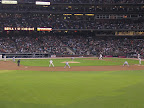
The biggest break of my 2006 trip occurred between the Dodgers and Angels game, so I had two days off in the Los Angeles area. In retrospect, I wish I had planned this trip a little differently so I would have had more time in San Francisco and San Diego rather than Los Angeles since I preferred those two cities. I stayed at a hotel in Anaheim that was walking distance from Disneyland. I didn't bother visiting the theme park though. On Saturday night, I met up with a couple of my West Coast buddies to see the Angels play the Mariners at Angel Stadium of Anaheim.

Angel Stadium is located in Anaheim. The name of the franchise has changed several times, from Los Angeles (when the Angels were actually playing in LA), to California, Anaheim, and now back to Los Angeles. Personally, I think Anaheim was the right city name for the team since Anaheim is a decent distance southeast of Los Angeles. The Angels are now officially known as the Los Angeles Angels of Anaheim. Why not of Anaheim, Orange County, California, USA, North America?

Angel Stadium of Anaheim, originally Anaheim Stadium and later Edison Field, is another one of the oldest remaining ballparks in the MLB. You certainly wouldn't know that by visiting the park today though. It has been renovated twice in its history due to tenant changes. It was originally built in the late 60's as the home of the Angels, who played their first few seasons at Dodger Stadium. Later, the NFL's Rams moved in and the stadium was converted to a multi-purpose facility with an upper deck surrounding the entire stadium. Finally, after the Rams moved to St. Louis in the mid 90's, it was converted back to a baseball only facility. The outfield upper deck was removed and the entire park received a makeover.

The current park really has no resemblance of a former football stadium. It looks like a typical baseball park with two large seating levels and a smaller club level in between. There is a single level of seats at field level in left field. The right field seats are elevated a bit, above the large right field wall. During the renovation, a rock pile with water fountains was added just beyond the left-centerfield fence, providing a nice scenic touch. Just outside of the stadium is the famous "Big A" sign and halo which is lit up when the Angels win. The stadium itself is often referred to as "The Big A".

Our seats were in the right field grandstands, up towards the top of the section. The only problem with the seats were that we could not see the portion of right field near the fence due to the high wall. Overall though, they were good seats and the price was right.

This is probably the best hitter's park in California, though not outrageously so. Plenty of home runs are hit to the alleys. The short fences near the foul poles allow fans to practically reach out and touch outfielders against the wall, if they so choose.

The ballpark certainly played small on this particular night, as my string of high scoring games continued, despite a pretty good starting pitching matchup. Gil Meche got the start for the Mariners and the Angels sent their ace, John Lackey, to the hill. Just like the previous games on this trip though, the starters really struggled.

Meche had trouble with his command in the early innings. In the second, he surrendered four singles, leading to a pair of Angles runs. Adam Kennedy and Chone Figgins had the RBI knocks for the Angels, but they wound up leaving the bases loaded. Meche settled down a bit after that, which is when Lackey's troubles began. After a pair of singles to start the top of the third, Mariners shortstop Yuniesky Betancourt doubled to right to score the Mariners first run. This was followed by an unusual play. Ichiro Suzuki grounded one to first. The runner on third wound up retreating to the base, but the runner on second had already decided to advance. So the Mariners lost an out when Betancourt was tagged out with two runners standing on third base. Fortunately for the Mariners, Jose Lopez hit a two run double later in the inning to give them a 3-2 lead.

Lackey ran into even bigger trouble in the top of the fifth. The Mariners had runners on second and third with one out when Lackey intentionally walked Raul Ibanez to get to Richie Sexson. That proved to be a big mistake as Sexson launched a grand slam to increase the lead to 7-2. The Mariners added one more run in the inning before Lackey was removed from the game, giving up eight earned runs. Things got even more out of hand in the seventh. Ichiro hit a three run home run and Adrian Beltre followed with another bomb to make it 12-3 Mariners.

The bright spot for the Angels on the night was rookie catcher Mike Napoli. He hit a pair of home runs: a solo shot in the sixth and a two run blast in the seventh. This was the second straight game on my trip where a player from the losing team hit two home runs. Rafael Furcal did the same at Dodger Stadium. The Angels scratched out a run in the eighth inning as well, but fell to the Mariners by a final of 12-6. Meche picked up the win despite giving up seven hits and four walks in just five innings. Both teams recorded 16 hits in the game and their were five total home runs.

The Angels were having a rough season to this point of 2006. They dropped to 27-34 after this game, which kept them in last place in the AL West. The Mariners improved to 30-34, a spot ahead of the Angels in the standings. The Angels wound up rebounding with a great second half to win 89 games, but did not make the playoffs. Meanwhile, the Mariners finished in last place.

On a personal level, it was fun to visit the place where my White Sox clinched the American League pennant the previous October. Side note: the Sox went 11-1 in the playoffs on their way to the World Series Championship. Their one loss? Game one of the ALCS against the Angels, the one game I attended. Tables were turned in 2008 though, when I was at the only playoff game the Sox won.

Angel Stadium of Anaheim is a very nice park. Despite being built in the 60's, this is really a much newer stadium than that. Although I was never there prior to the reconfiguration, I suspect the stadium is 100 times nicer now. After a fun Saturday night in Anaheim, I took off for San Diego the following morning for the last stop on my 2006 trip.

Photo Album

From Los Angeles Angels

From Los Angeles Angels

From Los Angeles Angels

From Los Angeles Angels

From Los Angeles Angels

From Los Angeles Angels

From Los Angeles Angels


Next stadium: Petco Park, San Diego

Saturday, January 2, 2010

Dodger Stadium

New York Mets @ Los Angeles Dodgers
June 7, 2006

Mets 9, Dodgers 7

W: Tom Glavine
L: Odalis Perez
S: Billy Wagner
HR: Lastings Milledge (NYM), Jose Cruz (LAD), Rafael Furcal 2 (LAD)
Attendance: 44,230
Time of Game: 2 hours, 48 minutes

Stadium Facts

Location: Los Angeles, CA
First Game: April 10, 1962
Capacity: 56,000
Type: Open
Surface: Grass

Following a couple days in the Bay Area, I decided to take the scenic route to Southern California. I drove along the Pacific Ocean on Highway 1. It was easily the most scenic drive I've ever made. Since I had a day off between games, I was in no rush. After spending Tuesday night in Santa Barbara, I drove to Los Angeles on Wednesday for my first visit to the nation's second largest city. After a little exploration, I found me way to Dodger Stadium for a Wednesday night game between the Dodgers and the Mets.

Dodger Stadium is located just north of downtown Los Angeles. It is situated in an extremely hilly area with the San Gabriel mountains providing a scenic backdrop to the stadium. The elevation of the stadium is quite a bit higher than downtown LA, because you can look down on the city from the area outside the park behind home plate. Palm trees also enhance the scenery around the stadium.

The ballpark was basically built into the side of a hill. If you walk into the stadium from the gates behind home plate, you are actually entering the top level of the stadium. From there, you can walk down several sets of steps to get to the gates that access the lower levels. However, the parking lots are beyond the outfield seats, so the gates nearest the lots are at ground level. Unlike most ballparks at or near major downtown areas, there is quite a bit of parking at Dodger Stadium. You better plan on it taking some time to get out of the lots after the game though.

Dodger Stadium is now the third oldest stadium in Major League Baseball (well behind Wrigley and Fenway), however it is well maintained and I doubt the Dodgers will be looking to replace it anytime soon. It is one of the largest baseball only facilities. There are three large seating levels in foul territory, plus a fourth level at the top of the stadium behind home plate. The second (loge) level is as large as you will see anywhere. I sat in the loge level down the first base line. The outfield features bleacher seating which is somewhat isolated from the rest of the stadium. The two outfield scoreboards are somewhat dated, but provide all the necessary information and are easily visible from all of the non-outfield seats.

This is another one of the great pitching parks. Although the wall is only 395 feet away to dead center, the distances to the gaps and down the lines are among the deepest in the league. The field is perfectly symmetrical too, so it does not provide an advantage to hitters from either side of the plate.

I don't normally like to talk about the local fans in these write-ups, because I don't think it is fair to judge a fan base on a single night. However, I feel compelled to mention that the behavior of Dodgers fans at this particular game was as bad as I've ever seen at a MLB game. It was especially odd considering this was a Wednesday night. There were at least three people escorted out of my section, including one who probably spent the night in jail after shoving a security guard. The woman sitting next to me had something stolen from her too. On top of all that, there were countless beach balls batted around and a wave started up with the Dodgers batting in a close game. I hate the wave to begin with, but it is completely inexplicable in a tight game when the home team is batting. But I digress...

The Mets and Dodgers squared up in the premiere matchup of this trip. The Mets were in first place in the NL East and the Dodgers were a close second in the NL West. Future Hall-of-Famer Tom Glavine was the starting pitcher for the visiting Mets. The veteran lefty was in the midst of the last outstanding season of his career, already compiling eight wins at this point in early June. On the other side, the Dodgers went with their own lefty, Odalis Perez, who was having a tough season. His troubles continued in this one as his ERA ballooned over 7.

The Mets tagged Perez right from the start. In the top of the first, they scored four runs, highlighted by a Jose Valentin double and a triple by rookie outfielder Lastings Milledge. Milledge's knock was the fifth straight hit for the Mets following a two out, nobody on situation. The Dodgers wasted no time scoring themselves. Rafael Furcal hit a leadoff home run in the bottom of the first to make it 4-1. The Mets got that run back in the second though. Carlos Beltan got an RBI single, knocking in Glavine who had walked to lead off the inning.

Glavine gave it all back in the bottom of the second. The Dodgers tied the game up with four runs, including a three run home run by Furcal, his second home run in as many innings. Furcal had already doubled his season home run total to four. Perez capped off his miserable night in the fourth by surrendering four consecutive singles and two more runs. In total, he was tagged for seven runs in just 3 2/3 innings. The Mets had a 7-5 lead when he departed. Glavine was not much better though. He gave up another leadoff home run in the bottom of the fourth to Jose Cruz Jr. to cut the Mets lead to one.

The scoring finally slowed down for a few innings. Milledge hit his second career home run in the top of the seventh. The two run shot extended the Mets lead to 9-6. The Dodgers had one more push in them in the eight. Nomar Garciaparra led off with a single, but was thrown out by Milledge trying to stretch it to a double. That wound up being costly because a walk and then a double by Andre Either only drew one run for the Dodgers as the headed to the ninth down 9-7. Billy Wagner came in to pitch for the Mets in the ninth and retired the Dodgers in order to pick up the save. Despite the shaky outing, Glavine picked up his ninth win of the season, which led the league at that point.

This was a very exciting game between two good teams. The Mets wound up winning their division with 97 wins while the Dodgers claimed the NL Wild Card in 2006. These two teams met in the Division Series, where the Mets swept the Dodgers prior to losing to the Cardinals in the NLCS.

Dodger Stadium is a great place to see a game. Despite being one of the oldest parks in baseball, I don't see any reason why the Dodgers would bother building a new stadium anytime soon. Although it was a rough night in the stands, Dodger fans have certainly supported their team well through the years, as they are always near the top of the league in attendance. Hopefully what I saw this night is not the norm for Dodger fans.

Photo Album

From Los Angeles Dodgers

From Los Angeles Dodgers

From Los Angeles Dodgers

From Los Angeles Dodgers

From Los Angeles Dodgers

From Los Angeles Dodgers

From Los Angeles Dodgers


Next stadium: Angel Stadium of Anaheim, Anaheim

Monday, December 21, 2009

AT&T Park

Florida Marlins @ San Francisco Giants
June 5, 2006

Giants 14, Marlins 2

W: Noah Lowry
L: Brian Moehler
HR: Josh Willingham (FLA), Barry Bonds (SF)
Attendance: 34,438
Time of Game: 2 hours, 39 minutes

Stadium Facts

Location: San Francisco, CA
First Game: April 11, 2000
Capacity: 41,503
Type: Open
Surface: Grass

After a ridiculously long hiatus, I am finally back to chronicling my trips to every MLB stadium. I should have enough free time coming up to get through the rest of these before the winter is over. Anyway, I left off following the first stop of my California trip. I went to a game in Oakland on a Sunday afternoon in early June of 2006. The following day, I crossed the bay and spent most of the day in the fun city of San Francisco. I walked all over downtown San Fran and even walked across the Golden Gate Bridge. Eventually, I found my way to AT&T Park, home of the San Francisco Giants.

I will start by saying that if I was forced to pick my favorite MLB stadium, I would probably go with AT&T Park. This park has it all. It is in a scenic location by the San Francisco Bay, on the edge of downtown San Francisco. The stadium runs right up against the bay, with just a narrow walkway separating it from the water. Pedestrians on that walkway can see into the park through the arches along the right field wall. During the summer, many people will take kayaks out on the water in hopes of having a home run ball come their way. That area, known as McCovey's Cove, was especially popular during the Barry Bonds era as he chased down the all-time home run record.

AT&T Park has had a variety of names in its decade history. Originally Pacific Bell Park, and later SBC Park, it received its current name in 2006, the season I visited. Opened in 2000, it was the first privately funded stadium to be built in 40 years. Like most of the stadiums built in this era, it has a classic ballpark look with all the modern amenities. The brick exterior and right field wall give the park a very classic feel. The lower level seats are right on top of the playing field. The upper deck seats provide a spectacular view of the bay as well as the rolling hills on the other side. A giant Coca-Cola bottle and glove are distinctive features beyond the left field seats.

In addition to the great scenery, location and amenities, I also love the layout of the field. There are a number of nooks and crannies along the right field wall. Although Barry Bonds often made the park look small, it is actually a tremendous pitchers park, particularly to right field. While Bonds used to hit balls into McCovey's Cove with regularity, not many other guys have done the same. The deep dimensions give outfielders a lot of ground to cover, but there are very few cheap home runs. This park rewards good pitching and defense. This is quite different than most other newer parks that reward marginal power hitters.

I wound up getting a ticket for the left field bleachers, which gave me a close up view of Barry Bonds patrolling left field. It was a pretty nice afternoon in San Francisco, but got very chilly when the sun went down. I was shivering in the late innings, even though I came prepared with a sweatshirt. I imagine cool summer evenings are fairly common in the Bay Area.

As expected, Bonds reception at AT&T Park was much different than I was accustomed to seeing elsewhere. They loved him in San Francisco, although it should be noted that this game was prior to the hard evidence of Bonds' alleged steroid use that has come out in recent years. Going into this game, Bonds was sitting on 715 career home runs. About a week prior to this game, he hit #715 to pass Babe Ruth for second on the all-time home run list. So, unfortunately, I just missed a chance to see a historic moment. However, Bonds didn't disappoint the fans in this game.

Noah Lowry got the start on the mound for the Giants. The lowly Marlins went with Brian Moehler, the first of two games I would see him pitch on this trip. It was a long evening for the visiting team. The Giants got things rolling in the bottom of the second. Following a pair of singles and a sacrifice, Randy Winn socked a triple to right field and scored on an errant throw to make it 3-0. Josh Willingham gave the Marlins a boost with a leadoff home run in the fourth, but it was all Giants after that.

In the bottom of the fifth, the Giants loaded the bases with three consecutive singles. Lance Niekro promptly unloaded them with a bases clearing triple to give the Giants a 6-1 lead and set the stage for Bonds. Bonds followed with a bomb to straight away center field, landing over the wall for career home run #716. I did not see Bonds play a ton of games in his career, but he seemed to hit a home run in most of them. This one chased Moehler from the game, with the Giants already ahead 8-1. The Giants added their sixth run of the inning on a single by Todd Greene.

With the game well in hand, the Giants relieved Lowry in the sixth. The Giants put together another huge inning in the bottom of the eighth. Six singles led to five more runs, including another RBI for Winn and Niekro. Niekro set a new career high with four RBIs in this game. By the time the inning was over, the Giants had two touchdowns on the board. The Marlins scratched out a run in the ninth to lose by a final of 14-2. It wasn't much of a game, but it was an exciting night.

The Marlins were really struggling at this time with a depleted roster. They dropped to 20-35 with this loss, but bounced back in the second half under rookie manager Joe Girardi. This wound up being Girardi's only season with the Marlins following a late season dispute with Marlins management. Meanwhile, the Giants improved to 30-27, but found themselves in third place. That is exactly where they finished the season, though they slumped to a sub .500 record.

AT&T Park is one of the "must see" parks in Major League Baseball. It has everything you could possibly want in a stadium. This park and game were probably the highlight of a very fun trip. San Francisco is a pretty cool city too. I would like to spend a little more time there sometime in the future. After a few days in the Bay Area, I started my trek to Southern California the following day.

Photo Album

From San Francisco

From San Francisco

From San Francisco

From San Francisco

From San Francisco

From San Francisco

From San Francisco


Next stadium: Dodger Stadium, Los Angeles